


The Blooket Dashboard is an important part of the Blooket experience. It gives teachers a…
Blooket Dashboard 2026: Complete Guide to Login, Features, Games and Reports
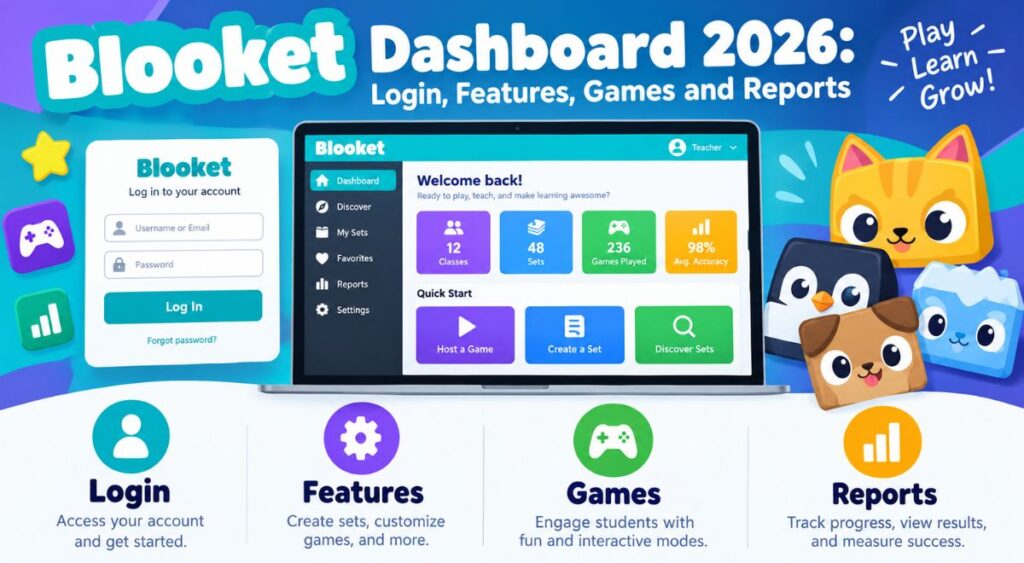
The Blooket Dashboard is the main place where users manage their Blooket account and classroom activities. Teachers can work with question sets, choose game modes, host activities, assign work, and review results. Students can join games, complete assigned activities, and use Blooket through a browser on their device.
Blooket combines quiz questions with game-based activities. Instead of using the same question-and-answer format every time, teachers can choose different game experiences around the same set of questions. The official Blooket website describes the basic process as getting a question set, choosing a game mode, and then playing, learning, and analyzing the results.
For someone searching for Blooket Dashboard, the first thing to understand is that the dashboard is different from the page used to join a live game. The dashboard is connected to the account experience, while the Blooket Play page is used to enter a Game ID and join an activity.
This guide explains the Blooket Dashboard in detail, including login, teacher and student features, question sets, hosting, homework, reports, game joining, mobile use, common problems, account safety, and frequently asked questions.
Blooket Dashboard at a Glance
Here is a quick overview before going into each feature.
| Dashboard Area | What It Is Used For | Main User |
|---|---|---|
| Account Login | Access a Blooket account | Teachers and students |
| Question Sets | Find or create quiz content | Mainly teachers |
| Game Modes | Choose how questions are played | Teachers |
| Hosting | Start a live classroom activity | Teachers |
| Game Joining | Enter a hosted game | Students |
| Homework | Complete assigned activities | Students |
| Reports | Review game performance | Teachers |
| Classes | Organize classroom users | Teachers |
| Blooks | Manage collectible characters | Users |
| Settings | Manage account information | Teachers and students |
| Solo Activities | Practice independently | Students and users |
The exact options visible to a user can depend on the account type, current Blooket features, and subscription.
What Is the Blooket Dashboard?
The Blooket Dashboard is the account and activity management area connected to Blooket.
A teacher can use Blooket to prepare a question set, select a game mode, start a classroom activity, and review the results. Blooket’s homepage currently emphasizes an easy setup process, an expanding collection of game modes, and detailed reports after games.
A student normally interacts with a different part of the service. For example, when a teacher gives students a Game ID, students can open the Blooket Play page and enter that ID to join. The current official Play page displays a Game ID field and a Join a Game option.
This difference is important because many people search for “Blooket Dashboard” when they actually need to join a game.
Blooket Dashboard vs Blooket Play
| Feature | Blooket Dashboard | Blooket Play |
|---|---|---|
| Account management | Yes | Limited |
| Teacher tools | Yes | No |
| Question-set management | Yes | No |
| Hosting | Yes | No |
| Game ID entry | No | Yes |
| Joining live games | Not the main purpose | Yes |
| Homework participation | Account/activity dependent | Yes |
| Reports | Yes | No |
| Settings | Yes | Limited |
The official Play page is specifically built around joining a game with a Game ID.
How to Log In to the Blooket Dashboard
To use account-based Blooket features, you first need to log in.
The current official Blooket login page provides a username or email field, a password field, a login button, Google sign-in, and a password recovery option.
Blooket Dashboard Login Steps
-
Open the official Blooket login page.
-
Enter your username or email.
-
Enter your password.
-
Select the login button.
-
If you use Google, select the Google login option.
-
After authentication, continue to your Blooket account.
| Login Option | Purpose |
|---|---|
| Username | Sign in with an existing Blooket username |
| Sign in using the account email | |
| Password | Verify account access |
| Sign in through Google | |
| Forgot Password | Recover access when the password is forgotten |
If you cannot remember your password, the official Blooket password-reset page asks for the account email.
What If You Cannot Log In?
A failed login does not always mean that the account is unavailable.
Try these basic checks:
-
Make sure the email or username is correct.
-
Check the password carefully.
-
Confirm that you are using the same login method used during signup.
-
Try the password recovery page if necessary.
-
Refresh the browser.
-
Check your internet connection.
-
Try another supported browser if the page does not load correctly.
Avoid entering your Blooket password into third-party websites that claim to provide special login access.
Teacher and Student Blooket Accounts
Blooket currently separates signup into Student and Teacher choices. The official signup page asks users to select which type of account they are creating.
The two account types have different purposes.
| Feature | Teacher Account | Student Account |
|---|---|---|
| Classroom activities | Yes | Participates |
| Create question content | Yes | Not the main purpose |
| Host games | Yes | No |
| Assign activities | Yes | Completes them |
| Review classroom results | Yes | Limited to own experience |
| Join games | Yes | Yes |
| Account settings | Yes | Yes |
| Blooket gameplay | Yes | Yes |
Students can also participate as visitors in certain situations without creating a full account.
Blooket’s current Terms of Service explain that students using a Game Code created by an account holder can access the service without creating an account. In that mode, students may provide a username and their responses can be collected for the activity.
Teacher Dashboard Features
The teacher dashboard is where most classroom management happens.
The main workflow is straightforward:
Choose Questions → Select Game Mode → Host or Assign → Students Play → Review Results
Blooket’s official homepage describes this same general workflow and highlights detailed reports as part of the experience.
Question Sets
Question sets are the foundation of a Blooket activity.
A teacher can use an existing set or create content for a particular lesson. The selected set supplies the questions while the game mode controls how students interact with them.
| Question Set Task | Purpose |
|---|---|
| Find a set | Use existing content |
| Create a set | Build custom questions |
| Edit a set | Adjust questions and answers |
| Organize sets | Keep content easier to manage |
| Reuse a set | Use the same content in another activity |
| Select a set | Prepare it for a game |
This separation between content and gameplay is useful because the same questions can be used in different activities.
Choosing a Game Mode
After selecting a question set, the teacher chooses how students will play.
Blooket’s official site says its library of game modes continues to expand.
The current homework interface also shows several available modes, including Fishing Frenzy, Zorblitz, Pirate Pool, Plushie Panic, Tower Defense 2, Monster Brawl, Tower Defense, Café, Factory, Crazy Kingdom, and Study.
| Game Mode Choice | What Changes |
|---|---|
| Game mode | Gameplay structure |
| Question set | Learning content |
| Time | Activity pace |
| Player participation | Who takes part |
| Game rules | How answers affect gameplay |
| Results | Performance information |
Because the questions and game mode are separate parts of the experience, teachers can change the gameplay without necessarily rebuilding the question content.
How to Host a Blooket Game
Hosting is the process a teacher uses to turn a question set into a live classroom activity.
A simple workflow looks like this:
Step 1: Select a Question Set
Choose an existing question set or prepare your own.
Step 2: Select the Game Mode
Choose the mode that fits the activity.
Step 3: Start the Game
Use the hosting controls to begin the activity.
Step 4: Share the Game Information
Students receive the information needed to join.
Step 5: Students Enter the Game
Students use the Blooket Play page and enter the provided Game ID. The current official Play interface shows a Game ID input and a Join a Game button.
Step 6: Start Playing
Once students have joined, the teacher starts the activity.
Step 7: Review Results
After the game, the teacher can use Blooket’s reporting features to examine performance.
| Hosting Stage | Teacher Action | Student Action |
|---|---|---|
| Preparation | Select questions | Wait |
| Game setup | Choose mode | Wait |
| Joining | Share Game ID | Enter Game ID |
| Gameplay | Monitor activity | Answer questions |
| Completion | End/review activity | Finish game |
| Analysis | Review results | Review own experience |
How Students Join Blooket
Joining a Blooket game is separate from managing the teacher dashboard.
The official Blooket Play page currently asks for a Game ID and provides a Join a Game option.
Blooket Join Steps
-
Open the Blooket Play page.
-
Enter the Game ID provided by the teacher.
-
Continue to the game.
-
Enter a nickname if requested.
-
Wait for the host to begin.
-
Answer the questions during the activity.
| Requirement | Needed? |
|---|---|
| Internet connection | Yes |
| Compatible browser | Yes |
| Game ID for live game | Yes |
| Full student account | Not always |
| Teacher-provided game | Yes for a hosted classroom game |
| Personal password | Not required for guest joining |
Blooket’s Terms confirm that certain students can use a Game Code without creating an account.
What Is a Blooket Game ID?
A Game ID is the information students use to enter a hosted game.
It should not be confused with the account dashboard or a password.
| Item | Purpose |
|---|---|
| Username | Identifies an account or player |
| Password | Protects an account |
| Game ID | Connects a player to a live game |
| Homework assignment | Connects a student to assigned work |
| Question set | Contains the educational questions |
If a Game ID does not work, the first step is usually to confirm that the teacher has provided the correct current code.
Blooket Homework
Blooket is not limited to games where everyone plays at exactly the same time.
The official Blooket site describes both live and asynchronous gameplay, while current Blooket homework pages show assignments with information such as the assignment title, teacher, deadline, and goal.
This makes homework useful when students need to complete an activity outside the classroom.
Homework Information
| Homework Detail | Meaning |
|---|---|
| Assignment name | Identifies the activity |
| Teacher | Shows who assigned it |
| Deadline | Indicates when it closes |
| Goal | Defines the required target |
| Game mode | Determines how the activity works |
| Student | Person completing the assignment |
A current Blooket homework page can show a goal such as a required number of correct answers and a due date.
Blooket Reports and Analytics
Reports are one of the most useful parts of the Blooket teacher experience.
Blooket’s official homepage specifically promotes detailed reports after each game and says they can help educators identify knowledge gaps and guide students toward success.
Instead of only seeing that a game was completed, a teacher can use available performance information to think about what students understood and where additional teaching may be useful.
| Report Area | Possible Use |
|---|---|
| Student performance | See individual results |
| Question performance | Identify difficult questions |
| Overall results | Review class activity |
| Accuracy | Look for learning gaps |
| Responses | Understand student answers |
| Game feedback | Plan follow-up instruction |
Why Reports Matter
Imagine a class completes a review game about fractions.
The teacher may notice that most students performed well on basic fraction questions but struggled with adding fractions with different denominators.
That information can help the teacher decide what to explain again.
The game creates engagement, while the report can provide information for the next teaching step.
Blooket Dashboard and Classes
For teachers working with groups of students, classroom organization becomes important.
Blooket’s Terms of Service specifically reference its Classes feature and explain that educational institutions and instructors have responsibilities when using student accounts and classroom functionality.
| Classroom Task | Why It Helps |
|---|---|
| Organize students | Keep classroom activity structured |
| Assign activities | Give students specific work |
| Review results | Understand performance |
| Manage student information | Keep classroom records organized |
| Track activities | Review previous work |
The exact dashboard options can change as Blooket updates the platform, so teachers should use the current interface shown in their account.
Blooket Dashboard and Blooks
Blooks are the characters associated with the Blooket experience.
They add a collectible and game-like element to the platform. The important distinction is that Blooks are part of the gameplay experience rather than the educational question content itself.
| Element | Purpose |
|---|---|
| Question Set | Provides questions |
| Game Mode | Controls gameplay |
| Blook | Represents the player |
| Game | Provides the activity |
| Report | Provides performance information |
This separation helps explain why Blooket can feel like a game while still being built around educational questions.
Blooket Dashboard on Mobile
Blooket works through web browsers, which makes it possible to use the service on different types of devices. Blooket’s privacy policy describes the service as a game-based learning tool that can be played through most web browsers.
Mobile vs Desktop
| Activity | Desktop/Laptop | Phone/Tablet |
|---|---|---|
| Log in | ✓ | ✓ |
| Join a game | ✓ | ✓ |
| Answer questions | ✓ | ✓ |
| View basic activities | ✓ | ✓ |
| Create content | More convenient | Smaller workspace |
| Manage classroom | More convenient | Possible |
| Review detailed information | Larger screen | Smaller screen |
| Host classroom activity | Convenient | Device dependent |
For students, a phone or tablet can be practical for joining and answering questions.
For teachers, a laptop or desktop can be more comfortable for creating content and reviewing detailed information because the larger display provides more workspace.
Blooket Dashboard on Different Browsers
Browser problems can sometimes look like account problems.
If the Blooket Dashboard does not load correctly, basic troubleshooting can help.
| Problem | First Step |
|---|---|
| Blank page | Refresh |
| Login problem | Recheck credentials |
| Game not loading | Check connection |
| Buttons not responding | Refresh browser |
| Old page showing | Clear cache if needed |
| Game connection issue | Check network |
| School network block | Contact school IT/admin |
Blooket’s Terms also state that certain website directories and cloud services need to remain accessible for the service to function properly.
This means that a school network, browser extension, or firewall can sometimes affect how an online educational service works.
Common Blooket Dashboard Problems
1. Blooket Dashboard Will Not Load
Try:
-
Refreshing the page.
-
Checking the internet connection.
-
Opening Blooket in another browser.
-
Checking whether a school network is blocking the service.
-
Logging in again.
2. I Cannot Log In
Check your username or email and password.
If you have forgotten the password, use Blooket’s official password recovery page.
3. I Cannot Join a Game
Make sure the Game ID is correct.
A live Game ID comes from the host. If the code has expired or the activity has ended, ask the teacher for the current game information.
4. My Homework Is Not Available
Check the assignment deadline.
Blooket homework pages can display when an assignment has closed.
5. A Feature Is Missing
Different account types and subscription plans can provide different functionality.
Check whether you are signed in to the correct account and whether the feature is included in the account or plan you are using.
Troubleshooting Table
| Problem | Likely Area | What to Check |
|---|---|---|
| Cannot log in | Account | Username/email and password |
| Forgot password | Account | Password reset |
| Game ID rejected | Game | Current code from teacher |
| Homework closed | Assignment | Deadline |
| Page is blank | Browser/network | Refresh and connection |
| Game disconnects | Network | Internet stability |
| Feature unavailable | Account/plan | Account type and plan |
| Student cannot join | Game setup | Correct Game ID |
Blooket Dashboard Safety and Privacy
Privacy is especially important for educational platforms because students may use Blooket through schools and teachers.
Blooket’s current Privacy Policy says the company aims to remain an ad-free service. It also explains that visitors invited to play a game or complete homework may only need to provide a username.
The policy also discusses school and student use, including student information, education records, and applicable privacy requirements.
Blooket’s Terms state that students using a Game Code can participate without creating an account in certain circumstances.
Privacy Overview
| Area | Blooket Information |
|---|---|
| Advertising | Blooket says the service is ad-free |
| Guest participation | Can use a username for certain activities |
| Student information | Subject to Blooket’s privacy practices |
| School use | Covered by specific school/student provisions |
| Account data | Managed through the user’s account |
| Data deletion | Account and data controls are provided |
The official Privacy Policy should always be checked for the latest details because privacy practices and legal requirements can change.
Blooket Account Security
Students and teachers should use normal account security practices.
Do not share your password with another person.
Do not enter your Blooket credentials into websites that promise free Blooks, automatic answers, cheats, or special dashboard access.
Blooket’s Terms specifically prohibit unauthorized cheats, bots, and hacks and also require users not to interfere with the service or its security systems.
| Safe Practice | Why It Matters |
|---|---|
| Use the official Blooket site | Reduces the risk of fake login pages |
| Keep passwords private | Protects the account |
| Use current game information | Prevents joining problems |
| Avoid unauthorized bots | Protects gameplay and accounts |
| Avoid suspicious extensions | Reduces security risks |
| Follow school rules | Keeps classroom use appropriate |
Blooket Free and Paid Services
Blooket provides free services and paid subscription options.
Its current Terms explain that some service plans require payment and that paid subscriptions can provide access to features not available through Blooket Starter. The available functionality depends on the selected plan.
Because subscription features can change, it is better to check the current Blooket pricing and plan information before relying on an old price or feature list.
| Area | Starter/Free | Paid Plan |
|---|---|---|
| Basic Blooket use | Available | Available |
| Core gameplay | Available | Available |
| Question-set activities | Available | Available |
| Additional features | More limited | Expanded depending on plan |
| Subscription | No paid subscription required | Payment required |
| Commercial permissions | Plan dependent | Depends on selected plan |
The Terms also state that paid plans may provide functionality not available through Blooket Starter.
Blooket Dashboard vs Other Quiz Platforms
Teachers often compare Blooket with other classroom quiz and learning platforms.
The main difference is not simply the number of questions. The experience depends on how the platform combines content, gameplay, classroom participation, and reporting.
| Platform Type | Main Focus | Typical Use |
|---|---|---|
| Blooket | Game-based review | Interactive classroom activities |
| Traditional quiz tool | Questions and answers | Assessment |
| Flashcard platform | Memorization | Individual study |
| Presentation quiz tool | Live participation | Classroom review |
| Learning management system | Course management | Full classroom workflow |
Blooket’s official homepage emphasizes game modes, question sets, live and asynchronous activities, and post-game reports.
That makes the dashboard particularly useful when a teacher wants the question content and game experience to work together.
How the Complete Blooket Workflow Works
The easiest way to understand the entire platform is to follow one activity from beginning to end.
Stage 1: Prepare
The teacher chooses an existing question set or creates one.
Stage 2: Select
The teacher selects a game mode.
Stage 3: Host or Assign
The activity can be run live or used as an asynchronous assignment, depending on the available setup.
Stage 4: Join
For a live game, students enter the Game ID on Blooket Play.
Stage 5: Play
Students answer questions while participating in the selected game format.
Stage 6: Finish
The activity ends when the game or assignment requirements are completed.
Stage 7: Analyze
The teacher reviews the available performance information.
| Stage | Teacher | Student |
|---|---|---|
| Prepare | Select/create questions | — |
| Select | Choose game mode | — |
| Start | Host or assign | — |
| Join | Monitor | Enter Game ID |
| Play | Monitor activity | Answer questions |
| Finish | End/review | Complete |
| Analyze | Review reports | Review activity |
This workflow is also consistent with the three-step process Blooket presents on its official homepage: get a question set, choose a game mode, then play, learn, and analyze.
Best Ways to Use the Blooket Dashboard
The dashboard becomes easier to manage when teachers keep their content organized.
Use Clear Question-Set Names
Instead of saving a set as:
Science Quiz
use a clearer name such as:
Grade 7 Science — Cell Division Review
This makes it easier to recognize the content later.
Match the Game to the Lesson
A quick review may need a different type of gameplay from a longer practice activity.
Choose the game mode after thinking about:
-
Lesson length
-
Student age
-
Number of questions
-
Learning goal
-
Classroom environment
Review the Results
Do not stop when the game ends.
Blooket’s official site specifically highlights reports as a way to identify knowledge gaps.
Reuse Strong Question Sets
A good question set can support several activities.
Instead of rebuilding the questions, a teacher can use the same educational content in another suitable game format.
Common Blooket Dashboard Mistakes
| Mistake | Why It Can Cause Problems | Better Approach |
|---|---|---|
| Using unclear set names | Hard to find content later | Use topic and grade |
| Ignoring reports | Misses available feedback | Review results |
| Sharing the wrong Game ID | Students cannot join | Verify the current code |
| Forgetting homework deadlines | Students may miss work | Check assignment dates |
| Using unofficial login pages | Account security risk | Use official Blooket pages |
| Sharing passwords | Account can be compromised | Keep credentials private |
| Assuming all features are identical | Plans can differ | Check current account features |
Frequently Asked Questions About Blooket Dashboard
Is the Blooket Dashboard free?
Blooket provides free services as well as paid subscription plans. The exact features available depend on the service plan.
How do I log in to the Blooket Dashboard?
Use the official Blooket login page and enter your username or email and password. Google sign-in is also available.
Can students use Blooket without an account?
Yes. Blooket’s Terms explain that students can access certain games through a Game Code without creating an account.
Where do I enter a Blooket Game ID?
Enter the Game ID on the official Blooket Play page. The page currently provides a Game ID field and Join a Game button.
Can teachers create their own question sets?
Yes. Blooket’s official website says teachers can find a question set from its library or create their own.
Can Blooket be used for homework?
Yes. Blooket supports asynchronous activities, and its current homework interface displays assignments with information such as the teacher, deadline, goal, and selected game modes.
Does Blooket provide reports?
Yes. Blooket’s official website highlights detailed reports after games and describes them as a way to identify knowledge gaps and guide students.
What should I do if my Blooket Game ID does not work?
First, confirm that the Game ID is correct and current. If the problem continues, ask the teacher or host for the current game information.
Can Blooket be used on a phone?
Blooket is designed to work through web browsers, so users can access it from compatible mobile devices as well as computers.
Is Blooket safe for students?
Blooket has specific privacy and student-use provisions in its Privacy Policy and Terms of Service. Schools and teachers also have responsibilities when using the service with students.
What is the difference between a Blooket account and a Game Code?
An account is used for account-based Blooket features. A Game Code is used to connect a player to a specific hosted game and can allow certain students to participate without creating an account.
Why can I see a Game ID but not teacher tools?
The available tools depend on the type of account and activity. A student joining a live game does not need the same classroom management tools as a teacher.
Conclusion: Understanding the Blooket Dashboard
The Blooket Dashboard is the central part of the Blooket account experience for managing educational activities. Teachers can work with question sets, choose game modes, host or assign activities, and review results. Students can join games, complete homework, and participate through their own accounts or, in certain situations, as guest players.
The simplest way to remember the platform is:
Question Set → Game Mode → Play → Results
The dashboard handles the management side of that process, while Blooket Play handles live game joining.
For teachers, the most important areas are question sets, game setup, assignments, classroom organization, and reports. For students, the most important steps are getting the correct Game ID, joining the activity, completing the questions, and following the teacher’s instructions.
Because Blooket continues to update its game modes, subscription options, and platform features, specific numbers and features can change over time. Checking the official Blooket pages is the safest way to confirm current account, pricing, privacy, and gameplay information.
Quick Blooket Dashboard Reference
| You Want To… | Go To / Use |
|---|---|
| Log in | Official Blooket Login |
| Create an account | Blooket Signup |
| Manage account | Blooket Dashboard |
| Join a live game | Blooket Play |
| Enter a Game ID | Blooket Play |
| Complete homework | Blooket Homework |
| Create questions | Teacher account tools |
| Host a game | Teacher account tools |
| Review results | Reports |
| Manage account information | Settings |
The key idea is simple: the Blooket Dashboard is the management side of Blooket, while Blooket Play is where players enter a Game ID and join an activity. Once you understand that difference, the rest of the platform becomes much easier to navigate.
Lorem ipsum dolor sit amet, consectetur adipiscing elit. Ut elit tellus, luctus nec ullamcorper mattis, pulvinar dapibus leo.
Latest Post
Introduction Online learning does not have to be boring. Teachers can use interactive platforms to make lessons more enjoyable. One popular option…
Introduction Online learning has changed the way teachers teach and students learn. Today, many teachers use digital tools to make lessons more…
Introduction The world of gaming has changed dramatically over the past few years. What was once considered a simple form of entertainment…
Introduction The internet regularly creates unexpected trends. Some begin as technologies, some start as online discussions, and others appear without a clear…